Maths Craft Festival 2016
- Auckland War Memorial Museum Museum Circuit Auckland, Auckland, 1010 New Zealand (map)
Maths Craft Festival 2016 was a weekend-long festival held at the Auckland Museum in early September, celebrating the many links between mathematics and craft. The Festival combined eight hands-on craft stations with a series of public talks, and was immensely popular, even making an appearance on One News. Over 1,800 people visited the Festival, trying their hands at a range of mathematical crafts, including crocheting hyperbolic planes, building fractal sculptures, making Möbius strips and folding origami dodecahedrons. The public talks were given by mathematicians and crafters, and covered topics ranging from the mathematics of knitting, and the Four Colour Theorem, to fractals in art and nature, and chaos and the crocheted Lorenz Manifold. The Festival was the largest event run at the Museum in over six months, and attracted a diverse group of people. Such an event wouldn't have been possible without our major sponsor Te Pūnaha Matatini.
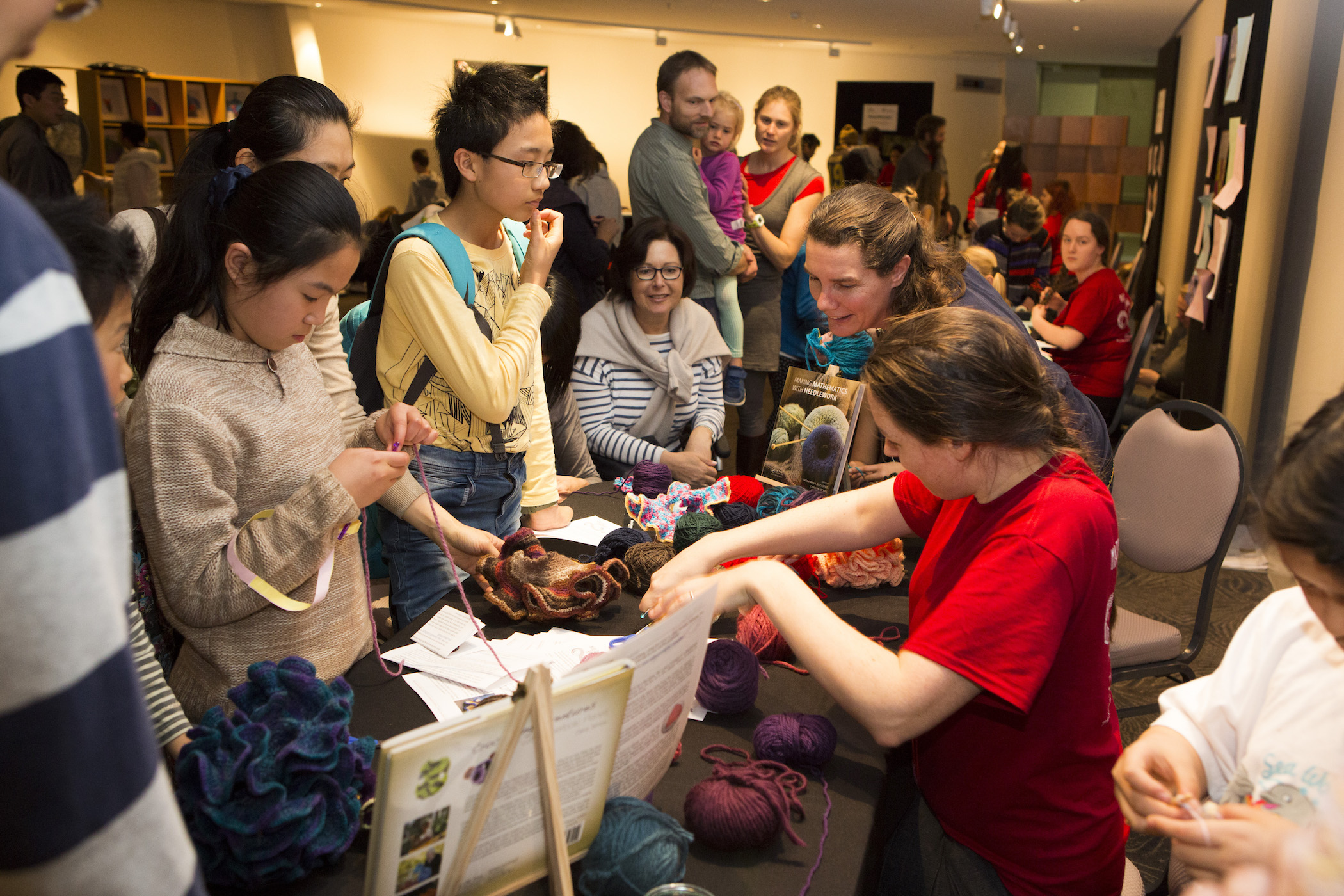
The positive feedback was overwhelming, with comments like “What a great event, our whole family has enjoyed it, from age 7-47!” and “Thank you for putting up such a cool event! Math is awesome”. What did people learn from attending the Festival? Aside from experiencing the “fascinating complexity and depth to all of the various constructions”, they were “amazed by how much breadth mathematics encompasses”, and have now come to realise that “Fractals are EVERYWHERE” and “Geometry is way cool”. And perhaps most heartening of all, that “Maths is exciting” and “maths can be fun!”
STATIONS
A range of stations gave attendees a chance to try various crafts for themselves while learning about the maths behind them.

Möbius strips are incredible mathematical shapes which have only one side and one edge. They can be knitted using a special cast-on method, or they can be crocheted, or they can be made using simply a strip of paper and a bit of sticky tape.
Explore these unusual shapes and find out what makes them so magical.
To hear more about the connections between mathematics and knitting, come along to the talk Knitting Mathematics by Julia Collins at 11am on Saturday.
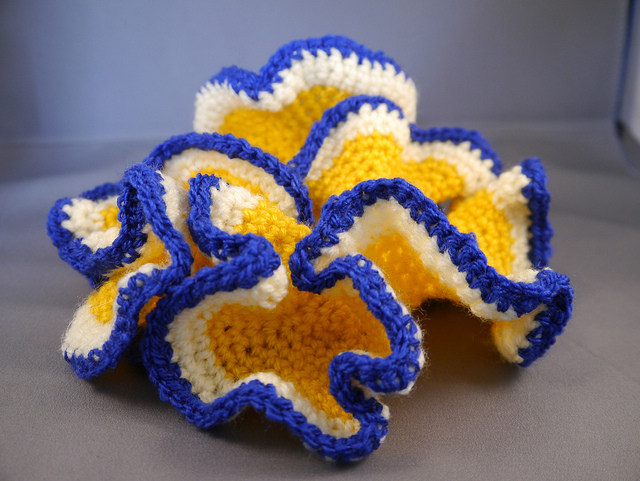
Crocheting objects that look like beautiful coral, kelp, funghi or leaves is actually very easy using a simple mathematical method. The resulting piece is an example of 'hyperbolic geometry', and took mathematicians hundreds of years to discover. By crocheting these pieces we learn more about mathematics and nature, and can ask questions about the shape of our own universe.
To hear the story behind an exceptional piece of hyperbolic crochet, come along to our public lecture Crocheting the Lorenz Manifold by Hinke Osinga at 4pm on Saturday.
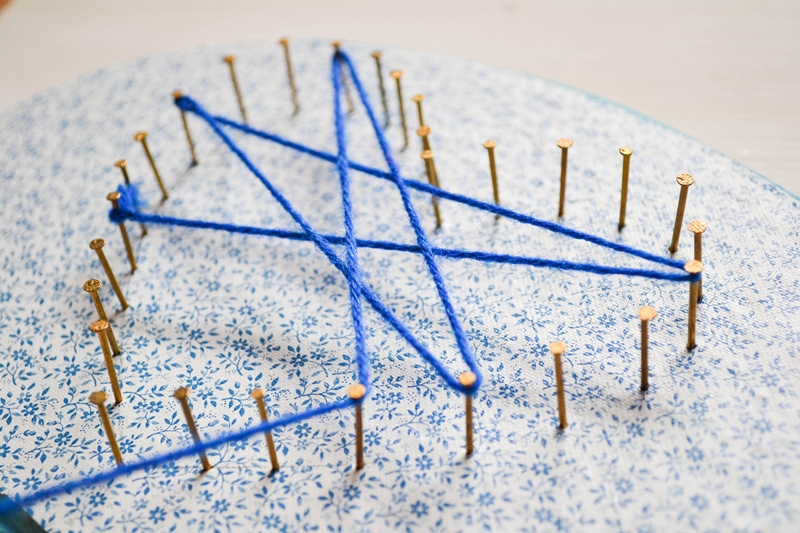
Using only a piece of string and some simple mathematical rules, you'll be amazed at the beautiful images you can create! Explore patterns in prime numbers, play with parabolas, create a mathematical heart, or invent your own patterns at our string art station.

We will have copies of the bestselling Snowflake, Seashell, Star by Alex Bellos and Edmund Harriss, with many intricate and beautiful mathematical patterns to colour in and explore. There will also be further mathematical designs to sit down and relax with, or, if you prefer, to challenge you in your colouring skills!
If you enjoy this station, you might enjoy our public lecture Graphs, Networks and the 4-colour Theorem by Jeanette McLeod, at 11am on Sunday.

By adapting a simple square tiling, even the most art-averse can create a beautiful tiling worthy of M.C.Escher himself! In this photo a 4th-grader made Bat Dog - what will you end up making?

Using a simple origami construction called a sonobe module, you can create wonderful mathematical shapes such as icosahedra or octahedra. Discover the beautiful symmetries in these shapes, investigate with colour patterns, and see if you can design your own origami creations!
If you enjoy this station you might enjoy our public lecture Mathematical Origami by Hugh Gribben, at 4pm on Sunday.

In 2014 a project was created to build the world's largest fractal, by assembling business cards to create a Menger sponge. Join us in re-living this fantastic project by building a Level 2 MegaMenger out of 2,400 business cards!
To find out about fractals, why not come to our public lecture Fractals, Carpets, Sponges and Snowflakes by Phil Wilson at 2pm on Saturday. Visit our Public Talks page for more information.
PUBLIC TALKS
We had a wonderful range of speakers over the festival weekend who explained some of the deep links between maths and craft.

Julia Collins is a mathematician and science communicator based at the University of Edinburgh in the UK. She is passionate about enthusing people about maths, and believes that maths can be found in everything around us. Knitting and crochet, in particular, have far more maths in them than people realise, and many mathematical ideas were discovered by knitters far earlier than by mathematicians! This talk will run through many different connections between maths and knitting, and will hopefully enthuse mathematicians and knitters alike to see their craft through new eyes.
Suitable for age 14+.

Phil Wilson is a mathematician at the University of Canterbury working in fluid mechanics and mathematical modelling in biology. In his talk he will tell us about the beautiful and incomprehensibly intricate world of fractals, and the role they have to play in nature.

Hinke Osinga is a Professor in Applied Mathematics at the University of Auckland. Her research in dynamical systems theory became well known to the general public in 2004, when she turned her computer-generated images of chaotic behaviour into a crocheted model, called the crocheted Lorenz manifold. The Lorenz manifold is a surface with an intriguing geometry that signifies the unpredictability of chaotic behaviour; it arises from a set of mathematical equations that represent a much simplified model for weather prediction. At over 25,000 stitches, the crocheted piece is about a metre wide and has been replicated by many crafters all over the world. If you want to be the first person to crochet one in New Zealand, come to this talk and hear what it is you will be making: Hinke promises a bottle of champagne as well as the honour of featuring on the crocheted Lorenz manifold website.

Jeanette McLeod is a mathematician at the University of Canterbury who does research into combinatorics, Latin squares, graph colourings and random graphs. In this talk she will tell us about one of the most controversial theorems of the 20th century, the Four Colour Theorem, explaining why mathematicians have struggled with it so much, and exploring its links with crafts such as knitting, quilting and colouring.

One of the research interests of mathematician Bernd Krauskopf of the University of Auckland is how chaotic behaviour may arise and can be explained mathematically. With Hinke Osinga and other collaborators he has been working on the famous Lorenz system, where the chaotic behaviour is organised by an amazing surface: the Lorenz manifold. Imagine a pancake that grows and grows to fill the entire space without creasing or developing self-intersections. This amazing object has been turned into a steel sculpture in a collaboration with artist Benjamin Storch. Bernd will highlight some of the underlying geometry of the Lorenz manifold and explain the process used to turn it into art.

Agnes Hauptli is a self-taught weaver living in Northland, New Zealand. She is passionate about the ancient craft of weaving, and will give her talk about the connections between mathematics, computer science, and looms. The Jacquard Loom can be considered as the first example of a working computer program, using punch cards to create beautiful woven tapestries as early as 1801. There is plenty more maths to be found in this intricate craft!

Hugh Gribben is a mathematician and educator who has had great success touring New Zealand with his Great Origami Maths and Science Show. His talk will explore the topic in more depth, showing how origami can be used to explore and visualise mathematical ideas, and even to prove mathematical theorems!
SPONSORED BY:

Te Pūnaha Matatini – ‘the meeting place of many faces’ – is a Centre of Research Excellence hosted by the University of Auckland that will develop methods and approaches for transforming complex data about New Zealand’s environment, economy, and society into knowledge, tools, and insight for making better decisions. Te Pūnaha Matatini were the first major sponsor of Maths Craft.

The University of Canterbury is New Zealand's second oldest university, founded in 1873. It offers world-class research, inspirational teaching, a vibrant campus environment and a great student lifestyle with students from around the world. The University of Canterbury’s first (undergraduate) degrees and higher (postgraduate) programmes aim to foster intellectual independence, critical thinking, and professional excellence in every field.

The Department of Mathematics at the University of Auckland is one of the largest and most diverse departments within The University of Auckland, covering Applied Mathematics, Mathematics Education and Pure Mathematics. It has a strong international reputation and offers degrees and diplomas that enjoy widespread recognition with employers in New Zealand and internationally.

The Dodd-Walls Centre is a world class collaborative research network building on New Zealand’s strength in the fields of quantum optics, photonics and precision atomic physics. Their research centres around photonics, the manipulation of light at the most fundamental, quantum level, and the control and manipulation of matter at the atomic scale, through the use of light.

The Auckland Museum Institute, established in 1867, is the membership body for Auckland Museum. The Institute is a facilitator of lifelong learning and knowledge sharing, engaging audiences through premium lecture programmes and events, in support of the Museum and its endeavours. It is the Auckland Branch of the Royal Society of New Zealand, providing members' and the public access to both local and international lectures.

Auckland War Memorial Museum is one of New Zealand's first Museums. The Museum tells the story of New Zealand, its place in the Pacific and its people. The Museum is a war memorial for the province of Auckland and holds one of New Zealand's top three heritage libraries. It has pre-eminent Māori and Pacific collections, significant natural history resources and major social and military history collections, as well as decorative arts and pictorial collections.
The mathematician Roger Penrose created an amazing tiling which is unlike any tiling you've seen on your kitchen floor or bathroom wall. His tiling is non-periodic, meaning that it never repeats, no matter how many tiles you lay down. Come and visit our Penrose room and see how big a Penrose tiling you can make!